Rate Limiting & QoS
Per-rule and per-owner caps for bandwidth, new-connection rate, and concurrent connections / flows. Hand-rolled token bucket; zero new dependencies.
Available since v0.11.0. Each cap is independently optional; absent fields preserve v0.10 behaviour byte-for-byte.
Cap kinds
| Cap | Effect when exceeded |
|---|---|
bandwidth_in_bps | Token-bucket throttle on inbound copy half. Connection is never closed — the read half parks until the next refill. |
bandwidth_out_bps | Same, outbound half. Each direction has its own throttle wall-clock counter. |
new_connections_per_sec | TCP accept-then-RST or UDP first-packet drop. |
concurrent_connections | Atomic fetch_add then cap check on accept (TCP) / first-packet (UDP). RAII guard releases the slot on close. |
bandwidth_in_bps, bandwidth_out_bps, and new_connections_per_sec
each accept an optional burst override; concurrent_connections does
not (it has no token bucket). Absent → burst = 1 × rate (one second of
tokens). Server validation clamps the burst to [rate / 100, rate × 60]
and rejects zero rates.
The rate limiter never closes existing connections — including under hot-reload that lowers a concurrent cap below the live count. A lower cap drains gracefully; new connections are rejected against the new ceiling.
Interaction with the splice fast path
The Linux TCP zero-copy fast path added in v1.3.0 is decided per connection at accept time. The predicate is exactly:
splice runs  ⇔  Linux  &&  TCP  &&  !PORTUNUS_DISABLE_SPLICE
              &&  rule has no  bandwidth_in_bps / bandwidth_out_bps
              &&  owner has no bandwidth_in_bps / bandwidth_out_bps
In plain terms:
| Rule shape | Data path | Reason |
|---|---|---|
| No bandwidth cap on rule and no bandwidth cap on owner | splice fast path | Nothing to shape; kernel pipe is byte-perfect. |
| Any bandwidth cap (rule or owner, in or out direction) | userspace path | Token-bucket shaper, byte-identical to v1.2.0. |
Important consequences:
new_connections_per_secandconcurrent_connectionsdo NOT disable splice. They are accept-time gates that run before the data path is chosen — they reject or admit a connection, but they do not shape its bytes. A rule withconcurrent_connections = 1000and no bandwidth cap still uses splice for the data plane.- Mixing capped and uncapped rules on the same server is fine — each connection picks its own path independently.
- Hot-reload that adds or removes a bandwidth cap only affects new connections. Existing connections keep their original path until they close.
- splice is TCP-only and Linux-only. UDP rules and non-Linux hosts always use the userspace path; caps apply identically.
- All cap metrics, audit fields, throttle counters, and reject behavior are unchanged by splice. See Metrics.
Enabling splice never disables a QoS feature: capped rules skip the speedup, uncapped rules get it.
Per-rule caps
portunus-server push-rule edge-01 443 backend.local:8080 \
  --bandwidth-in-bps 1048576 \           # 1 MB/s in
  --bandwidth-out-bps 524288 \           # 512 KB/s out
  --new-connections-per-sec 100 \
  --concurrent-connections 1000 \
  --bandwidth-in-burst 2097152           # optional burst override
Burst flags are --bandwidth-in-burst, --bandwidth-out-burst, and
--new-connections-burst.
The list-rules human output gains a compact CAPS column showing
the active caps per rule.
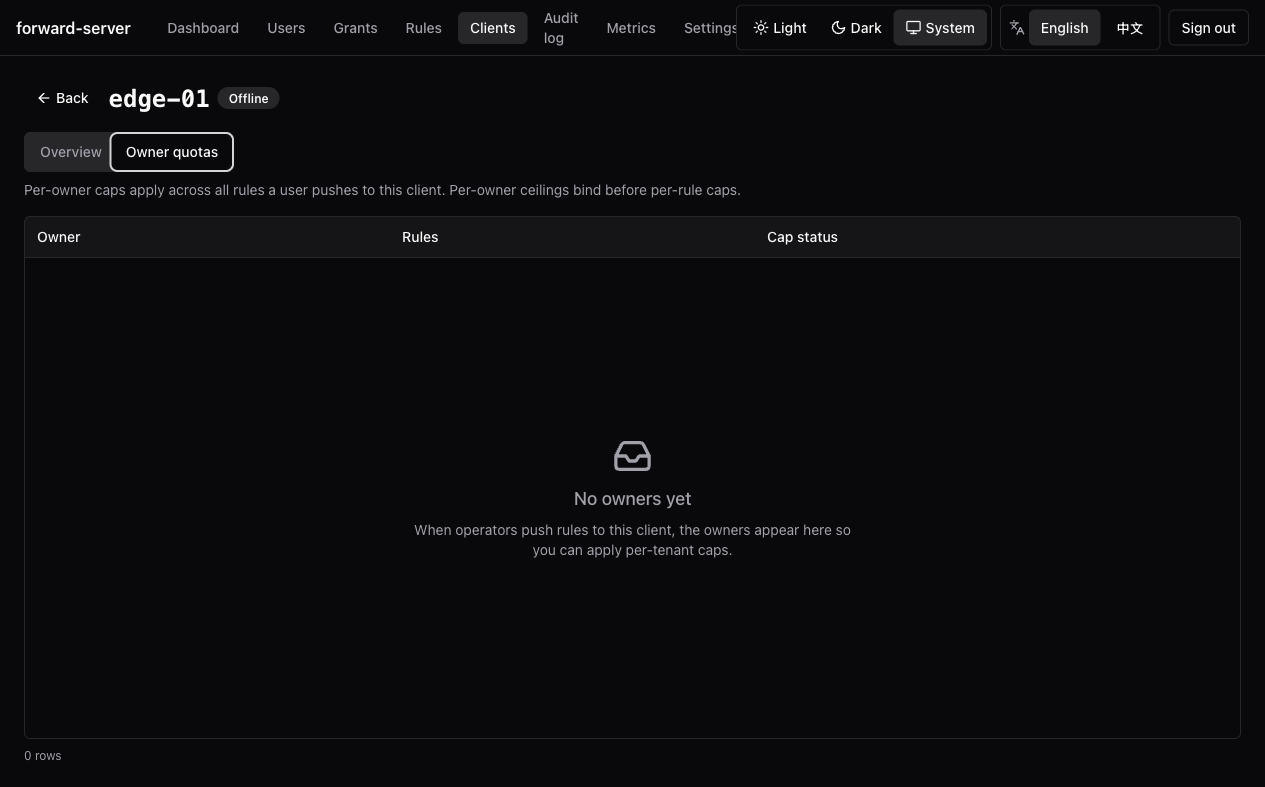
Per-owner ceilings
A per-owner ceiling caps the aggregate across every rule owned by
that user on a given client. The envelope is keyed (client, owner).
Per-owner caps bind before per-rule caps — rejects carry distinct
owner_* reasons.
# Set Alice's envelope on edge-01
portunus-server owner-cap set edge-01 alice \
  --bandwidth-in-bps 10485760 \         # 10 MB/s aggregate
  --concurrent-connections 5000

# Inspect
portunus-server owner-cap get edge-01 alice
portunus-server owner-cap list edge-01

# Remove
portunus-server owner-cap delete edge-01 alice
REST surface: /v1/clients/{client_id}/owners/{owner_id}/rate-limit
(list owners at /v1/clients/{client_id}/owners).
Reject reasons
Six values surface on portunus_rate_limit_reject_total{reason=…}:
conn_concurrentconn_rateudp_flow_rateowner_concurrentowner_conn_rateowner_udp_flow_rate
The owner label is empty for per-rule rejects and populated
for owner-scoped rejects.
Hot-reload
Cap mutations swap the rule's Arc<RuleRateLimiter> while preserving
tokens and last_refill_micros carryover, so:
- Raising the cap doesn't mint a free burst.
- Lowering the cap doesn't strand the existing token pool.
- Lowering the concurrent cap below the live count drains gracefully — no forcible close (FR Q4).
Since v1.7.0, a rule's per-rule limiter is reclaimed when the rule is removed (previously it leaked).
Capability gate
Pushing rate_limit (or any owner-cap mutation) to a v0.10-or-earlier
client returns HTTP 422 rate_limit_unsupported_by_client before any
rule activates anywhere.
Reject path: TCP accept-then-RST
Portunus does not pause the listener on a capped rule, because
v0.7 / v0.9 share listeners across rules — pausing would penalise
sibling rules. Instead, capped rejects accept the connection, mark it
with SO_LINGER {l_onoff: 1, l_linger: 0}, and close, producing a
clean RST visible to the client.
Metrics
portunus_rate_limit_reject_total{client,rule,owner,reason}
portunus_rate_limit_throttle_seconds_total{client,rule,owner,direction}
portunus_rate_limit_active_connections{client,rule,owner}
Data-plane reject and throttle events are tracing-only — they do not enter the SQLite operator audit ring (mirrors the v0.9 D13 invariant).
Web UI
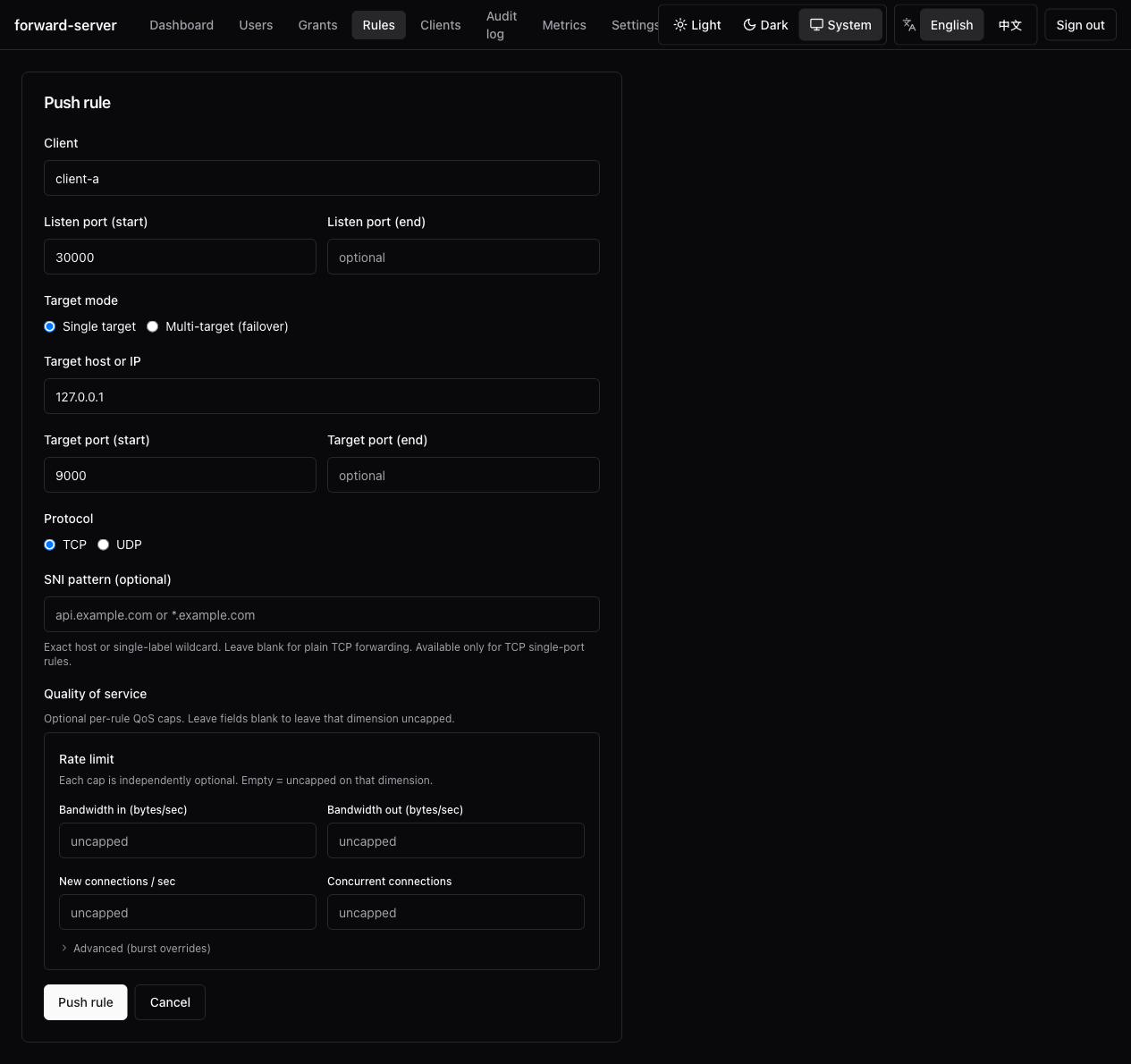
The rule editor gains a "Quality of service" section (cap inputs,
burst overrides folded behind an "Advanced" disclosure). The rules
table gains a compact Caps column. The client detail page gains an
Owner quotas tab where superadmins manage per-owner envelopes.